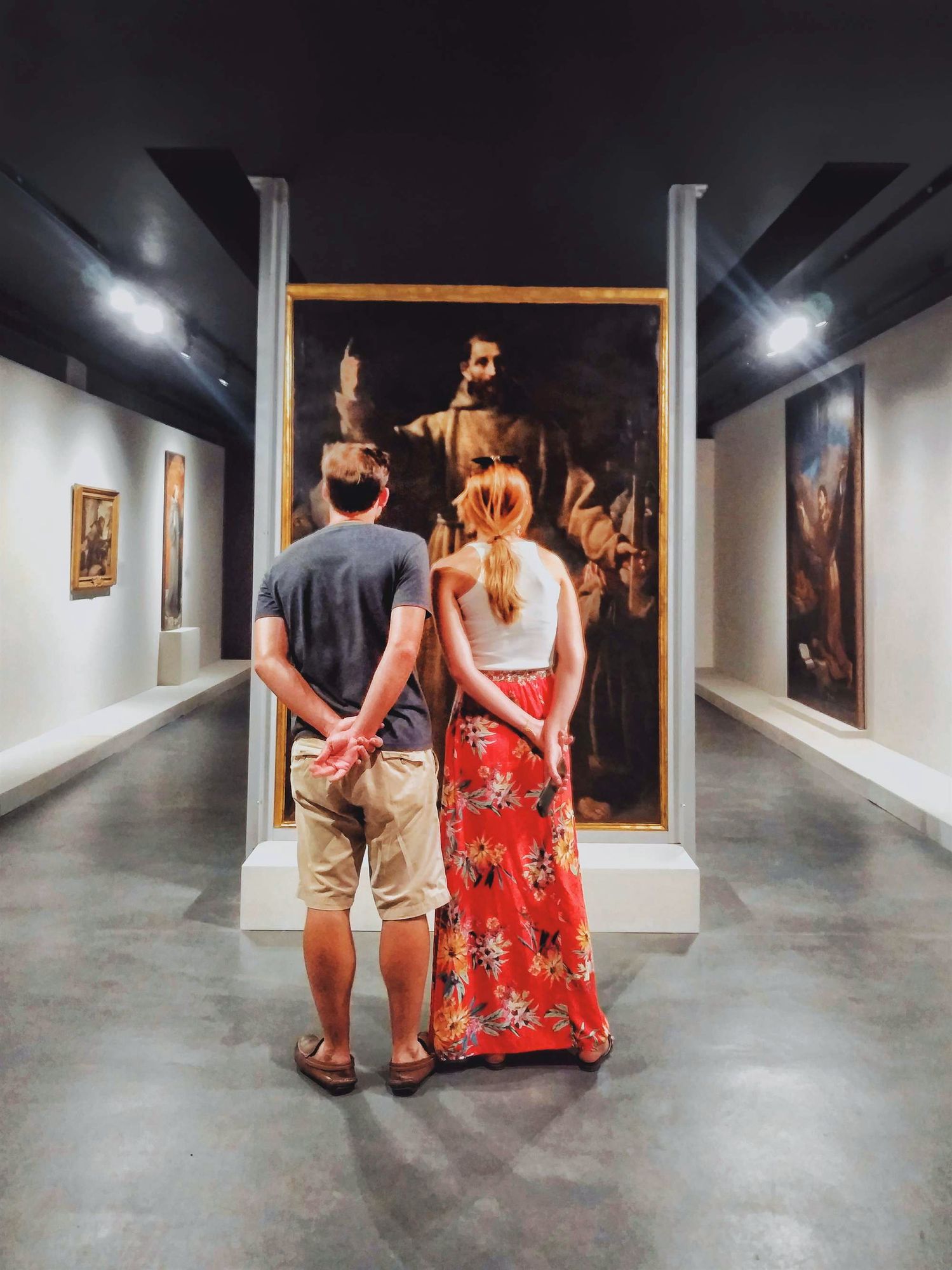
Every bad visit to the Prado begins the same way: with the intention of seeing everything. Two and a half hours later you come out with your memory scrambled, your feet aching and the vague impression of having passed a great many important things without having looked at any of them.
Human attention in front of painting is short and measurable. After the second hour, most people stop registering. That is not a lack of culture, it is physiology. A two-hour route with eight stops leaves more memory, more understanding and more pleasure than four hours walking through rooms.
What follows is a route we use often, with the logic behind each choice. It is not the only one possible, and it does not claim to be a canon. It is a sequence that works because it tells a story instead of listing masterpieces.
Before you go in: three decisions that shape the visit
The hour. The first hour after opening is the best of the whole week, on any day. The last two hours of the afternoon are the second best option, with one important caveat just below.
Avoid the free entry slot. The Prado opens a period of free access at the end of the day. It is a generous policy and a poor idea for a first visit: the rooms fill, the flow is quick, and you end up competing for space in front of exactly the works you came to see. Paying for a ticket is the most obvious economy of a trip.
Book a timed entry. Not so much for the queue, which usually moves, but because a fixed time organises the whole day around it.
The route, in eight stops
1. Bosch, The Garden of Earthly Delights
Starting here is deliberate. It is the strangest work in the museum, it paints paradise, the world and hell across three panels, and it needs no training at all to hold anyone for ten minutes. Children are hypnotised by it. Adults who are sceptical about museums change their posture in front of it.
It is worth knowing that Philip II acquired the work and took it to El Escorial, and that it reaches the Prado by that route. The royal collection explains almost everything this museum is: it was not assembled by curators, it was accumulated by kings with their own taste and a great deal of money.
2. Titian, portraits and mythologies
After the Flemish delirium, the Venetian contrast. Titian was painter to Charles V and then to Philip II, and the quantity of his work here is a direct consequence of that. It matters less to memorise titles than to notice the change of temperature: the Venetian red, the flesh, the substance of paint applied with freedom.
This is the moment at which you understand why Velázquez, a hundred years later, looked so hard towards Venice.
3. El Greco, The Nobleman with his Hand on his Chest
A small, austere portrait, the hand in the foreground and a gaze that follows you. It serves to introduce the Spain of Toledo, the religiosity of the period and a painter who was Greek, trained in Venice and ended up in Castile. Five minutes here are enough, and they prepare the ground for what comes next.
4, 5 and 6. Velázquez, three works in sequence
The centre of the museum and the centre of the route. The recommendation is to see three, in this order, and not to rush off after the first.
Las Meninas is the most analysed painting in the Western tradition and it holds up the fame. It is worth spending the time to ask where the painter is, who is being portrayed, what the mirror at the back is doing and why the king and queen appear where they appear. Ten minutes here give back more than an hour in any other room.
The Spinners, Las Hilanderas, tends to be crossed at speed and is possibly the most modern thing in the museum: a scene of work in the foreground, a mythological scene behind it, and a wheel that Velázquez paints as a blur of movement two centuries before anyone thought of impressionism.
The Surrender of Breda shows the victor preventing the defeated man from kneeling. It is propaganda painting with an unusual dose of humanity, and it explains a good deal about the image the Spanish empire had of itself.
7. Goya, The Third of May 1808
The change of register. The light of the lantern, the open arms, the line that continues into the dark, the faces of the soldiers that we never see. It is one of the first times in the history of painting that war appears with no heroism in it at all. After this, nothing in the next room sounds the same.
8. Goya, the Black Paintings
Ending here is a hard choice and it is worth making. These are the paintings Goya made directly on the walls of his house in his last years, deaf, ill and with no intention of exhibiting them. Saturn Devouring his Son is the best known. The Dog, almost empty, an animal's head sinking into an undefined surface, is usually the one that stays with people.
It is not a pleasant ending, and that is exactly why it works. You leave the museum with something in your head rather than a blur of three hundred images.
The one museum a day rule. The Prado, the Reina Sofía and the Thyssen in a single day is not efficiency, it is cancellation. All three collections are large, dense and ask for different mental registers. Two well-chosen hours in the Prado in the morning and a free afternoon give back infinitely more than a whole day divided between three museums. On a trip of five days there is room for all three, comfortably, on separate mornings.
What is left out, and why
This route sets aside Rubens, Ribera, Zurbarán, Murillo, Fra Angelico, Raphael and most of the Italian and Flemish painting in the collection. That is not disdain, it is arithmetic: eight works in two hours gives fifteen minutes each including the walking between them, and that is already generous.
On a second visit the route changes completely. That is when Rubens comes in, along with the Flemish rooms, the less celebrated court portraits and the particular pleasure of walking without a list.
Three variations
With children. One hour, ninety minutes at the very most. Start with the Bosch, go straight to Las Meninas, and choose one work with an animal, a monster or a battle in between. Turn it into a story, not a visit. Seven or eight works is the absolute ceiling.
For anyone who already knows the Prado. Do the opposite: choose a single painter and stay with him alone. A complete Goya route, from the cheerful tapestry cartoons to the Black Paintings, is one of the most striking experiences the museum offers, and almost nobody does it.
With an art historian. Two hours with someone who knows the collection change the nature of the visit, particularly for anyone with little familiarity with old master painting. It is one of the few cases in which a private guide pays for itself in five minutes.
After the museum
One thing we almost always recommend: do not slot anything demanding in behind it. The Prado takes more out of you than it appears to. The Retiro is a few minutes away on foot and is the exact antidote, and the hour after a good visit is frequently the best conversation of the trip.